A Brain That Operates Beyond Sight
In the real world, whether on solar farms, airports, or mountain slopes, relying on satellite signals alone is not an option. Tall grass, panel structures, or dense vegetation make conventional navigation methods unreliable. Our solution is therefore built on the fusion of data from several key sources: advanced radar sensors that we develop in-house, SLAM (Simultaneous Localization and Mapping) algorithms, and artificial intelligence. Thanks to SLAM, a machine can create a map of its surroundings in real time while simultaneously determining its precise location within it, all completely independent of GPS.
From Precise Navigation to Greater Efficiency
What does this technological advantage mean in practice? Concrete, measurable results.
-
- Radically Reduced Demands on the Operator: Thanks to more precise environmental perception and smarter route planning, the machine can resolve significantly more situations on its own. This fundamentally reduces the need for human supervision and intervention, allowing a single operator to efficiently manage multiple machines at once.
- Intelligent Response: Machines can now actively avoid unknown obstacles and replan their routes in real time, without needing an operator’s intervention.
- Energy Self-Sufficiency: The transition to a fully electric powertrain also paves the way for near-continuous operation. The new generation of machines will be able to recharge themselves at docking stations, radically reducing the need for human assistance.
The Future is Fully Autonomous
We are not stopping here. In collaboration with the Czech Institute of Informatics, Robotics, and Cybernetics (CIIRC CTU), we are working on the next step in this evolution. Our immediate goal is to increase the autonomously managed area to 95%. The target for 2026 is a machine that can map an unfamiliar environment entirely on its own and automatically plan the most efficient workflow. Time-consuming manual mapping will become a thing of the past.
A Platform for Any Machine
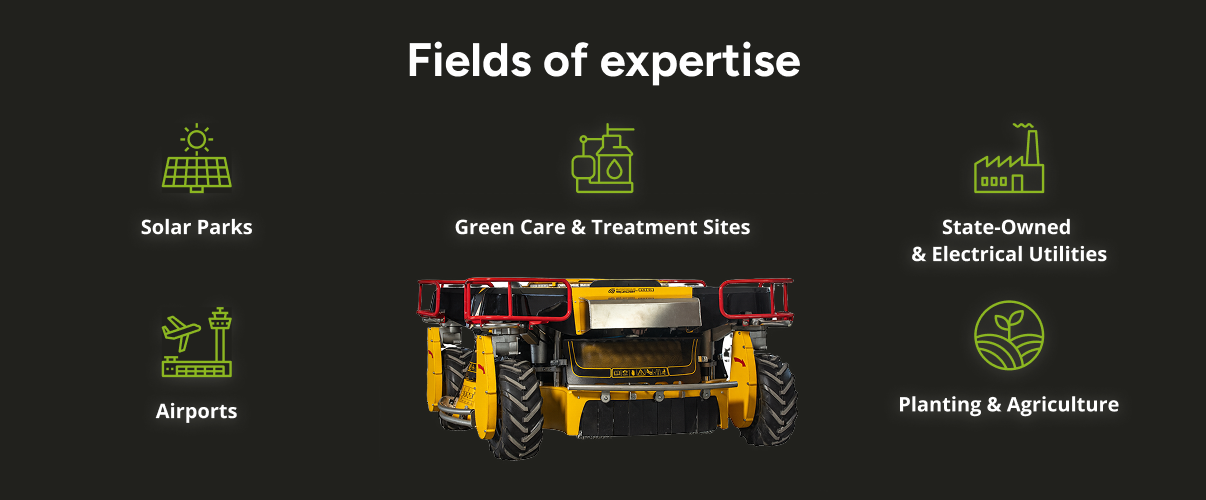
Our new control unit is not just an upgrade for the Spider mowers that serve as our primary testing ground. It is a robust, modular, and scalable platform ready for integration into a wide range of specialized machinery—a fact proven by the recent implementation into Swiss Monotrac mountain tractors. We provide the brain that can transform almost any machine into an intelligent and independent robot. A new generation of autonomy is here, and it’s powered by Smaut technology.