“Thanks to our autonomous driving technology connected to radars and electric drive, the ability of industrial robotic mowers to work independently has increased. We are now working on enabling robots to recharge themselves from energy produced in managed power plants. This will make operation many times cheaper than combustion engines or electricity from the regular grid. What’s more, operation will be virtually emission-free,” says the young electrical engineer, describing the technology.
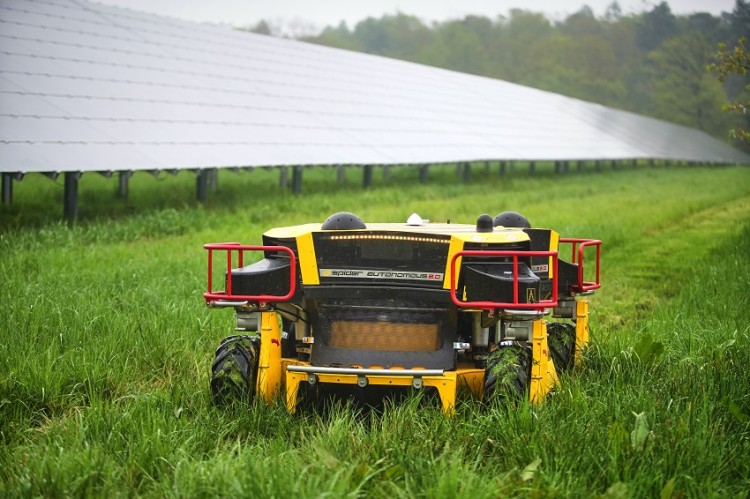
In 2023, Smaut technicians were the first in Europe to certify the Spider mower, manufactured by another Czech company, Dvořák-svahové sekačky, for autonomous operation using their unique technology. “The Spider, which we have fine-tuned, can now drive and mow on its own in fenced-in solar park areas,” adds Alan Ilczyszynn, director of Smaut. The price of a Spider machine equipped with Smaut’s autonomous technology is approximately two million Czech crowns, and the company from Český Brod has already installed several dozen of them.
Vincenc Šopík founded Smaut with friends after years of experience in building solar parks, of which they have constructed more than a hundred. Smaut is based on a division of his construction company, which has been involved in the maintenance of greenery and grass cutting at solar power plants since 2015. “Every year, we mow over 6,000 hectares of solar power plant areas using autonomous mowers, mowing tractors, and brush cutters. In 2017, we started thinking about streamlining and automating the maintenance of solar parks. A fleet of medium-sized mowers seemed like the ideal solution. We developed technology to make them autonomous, so the operator brings them to the site, turns them on, and they take care of the rest completely on their own,” Šopík explains.
Mowing in solar parks takes place twice a year, as grass and self-sown trees must not shade the panels. This could result in reduced performance and ultimately complete blindness and replacement. “Autonomous machines are ideal for maintaining solar parks because they cover huge areas the size of dozens of football fields, so maintaining them using human labor is very demanding,” says Šopík, evaluating his years of experience. In the beginning, they tried traditional methods with teams of mowers and available gardening equipment. However, they soon realized that this was not a viable option due to costs and a lack of manpower. “In addition, I realized that I am a technician by nature and not a gardener, so we decided to focus on robots and their development. The potential of our technology is enormous, and most importantly, there is no competition for our solution. Our huge advantage is that we are constantly testing the machines in real-life conditions at the solar power plants we manage,” he concludes, describing the machines, which weigh 350 kilograms, are equipped with a special control unit, and are connected to advanced navigation systems with radars and sensors.
Stroj se díky tomu dokáže sám, dle přesného plánu pohybovat ve vysoké trávě v terénu s překážkami a konstrukcemi pro panely. Smaut má dle Šopíka další velké plány a v žádném případě nechce do budoucna působit jen na solárních elektrárnách. Pilotní jednání již probíhají například i s českým Ředitelstvím silnic a dálnic.