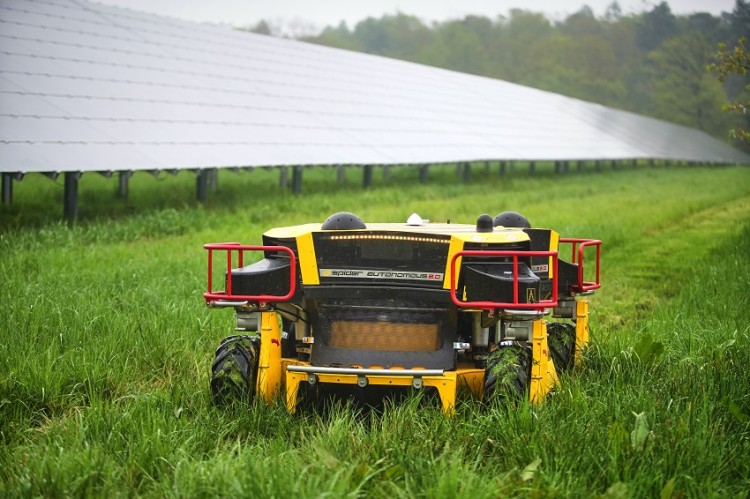
Machines equipped with technology developed by domestic developers are already mowing grass in solar power plants covering an area of over 4,000 hectares. The use of autonomous control eliminates a large part of the demanding and dangerous human work and results in cost savings of 30%. In 2023, SMAUT was the first in Europe to obtain certification for its machines, which allows their autonomous use within a limited environment.
Until now, the robots have been powered by a conventional gasoline engine, but the switch to electric drive will reduce the cost of operating the machines several times over and eliminate the need for regular refueling, which requires an operator.
“The electrification of our machines is far from being just a question of ecology or savings in operation. The significant change is that the robots will now be able to recharge themselves at docking stations. This will significantly reduce the need for human intervention and extend the time of independent autonomous operation. If they work in solar power plants, they will even use the energy produced on site,” says Vincenc Šopík, co-owner of the company and director of research and development.
The new generation of machines will also be approximately 15 cm lower, which will enable mowing under solar panels, where robots have not been able to fit until now. While the machines currently mow around 50% of the area in power plants, this will now increase to 85%. Hand in hand with the change in the machines themselves, SMAUT has also advanced in the development of radar technology, which plays a key role in orienting the machine in tall grass or under panels, where GPS signals cannot be relied upon. This is complemented by advances in the algorithms and AI used, which enable robots to learn to work with new obstacles and plan the most efficient routes themselves. Over time, the operator’s only task will be to transport the machines to the site and assist them in making decisions in new situations.
We are not gardeners, we are technicians
SMAUT was founded by a group of Czech entrepreneurs with several years of experience in the construction of solar power plants. According to Vincenc Šopík, there are a number of problems associated with the operation of solar power plants. Among the biggest are the need for regular grass cutting, panel cleaning, and cable connection checks. Grass and dirt reduce the performance of the panels and can lead to their irreversible “blinding” and the need for complete replacement. In addition, the power plants cover huge areas the size of dozens of football fields, so managing them using human labor is quite complicated.
“We have built more than a hundred large solar power plants that produce almost 2 GWp of energy. To give you an idea, that is more than half of the total production of all solar power plants in the Czech Republic. We then began to take care of a number of the projects we had built, initially using traditional methods. So we hired a team of mowers and bought increasingly powerful gardening equipment. However, we soon realized that this was not the way forward due to the costs and lack of people. Moreover, I am a technician by nature, not a gardener, so we decided to rely on robots,” says Vincenc Šopík.
According to Vincenc Šopík, the biggest challenge is ensuring autonomous operation of machines in terrain where the machine cannot “see” and where there are many obstacles. The autonomous solution developed by SMAUT is based on a specially developed control unit and software. Everything is connected to advanced systems such as the global navigation satellite system, inertial navigation, lidar and radar technology, ultrasonic sensors, and telemetric sensors. The mower itself weighs around 350 kilograms and must be able to move in difficult terrain with tall grass and numerous obstacles.
Expansion into new areas and markets
SMAUT robots were originally created for mowing grass at solar power plants, but new tasks await them there, such as checking cabling and cleaning panels. According to Šopík, however, SMAUT does not want to limit itself to solar power plants.
“We have two directions of expansion. One is mowing grass in other places where human labor is dangerous and expensive. The second direction is cooperation with manufacturers of various specialized machines who need to robotize their products,” explains Vincenc Šopík. SMAUT is already celebrating its first successes in both directions. For example, Czech robots are now mowing grass in the electrical substations of the Austrian railways and will soon begin taking care of the airport in Birmingham, England. SMAUT has also recently established cooperation with the Swiss manufacturer of Monotrac electric single-axle tractors, which are used, for example, for ecological grass cutting in the extreme conditions of steep Alpine slopes, snow milling, or soil cultivation. The implementation of Czech autonomous technology will increase the safety and efficiency of tractors.
“The potential of our technology is enormous, and there is no competition for our solution yet. One of our significant advantages is that we are constantly testing the machines in real-world operation at the solar power plants we manage,” concludes Šopík.