Autonomous solutions
Operators of parks, which are being built on a massive scale throughout Europe and especially in Germany, soon discovered that it is not enough to simply build power plants; regular maintenance is necessary to maintain their performance. There are a number of problems associated with the operation of solar power plants. Among the biggest are the need for regular grass cutting, panel cleaning, and cable connection checks.
Grass and dirt on the panels reduce their performance and can lead to irreversible “blinding” and the need for complete replacement. In addition, power plants cover huge areas the size of dozens of football fields, so managing them using human labor is quite complicated.
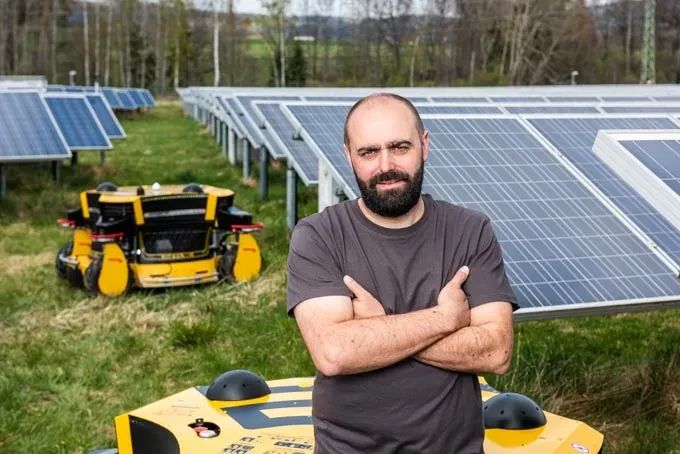
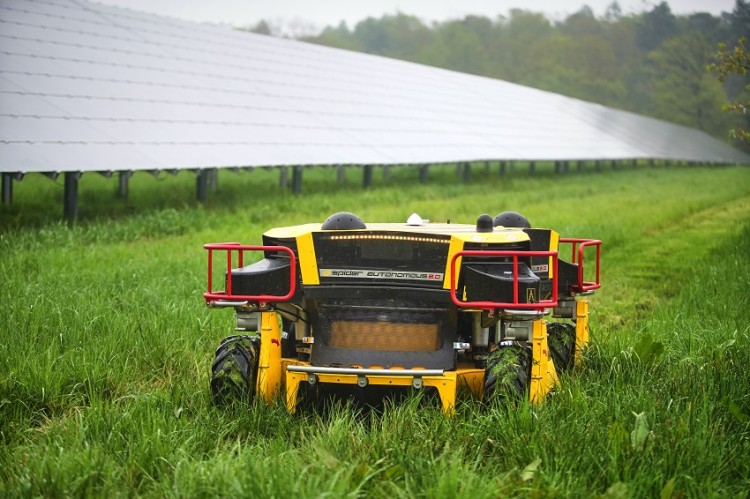
The autonomous solution developed by SMAUT is based on a specially developed control unit and software. Everything is connected to advanced systems such as the global navigation satellite system, inertial navigation, lidar and radar technology, ultrasonic sensors, and telemetric sensors. The mower itself weighs around 350 kilograms and must be able to navigate difficult terrain with tall grass and numerous obstacles.
Currently, autonomous mowers can mow up to 70% of the power plant area and work independently for several hours. SMAUT wants to improve both of these aspects. The first step is to switch to electric mowers, which will further simplify the entire operation and eliminate the need for frequent refueling. According to Vincenc Šopík, co-owner of the company and director of research and development, the goal is to have fully autonomous machines that can operate without an operator for ten hours next year and up to seven days in the future, and will also be able to mow grass in areas with limited space. Such areas still have to be mowed manually.
Cooperation with CTU
“We are working with the Institute of Robotics and Cybernetics at CTU to develop an algorithm that will make our machines virtually unattended within two years. Artificial intelligence will teach them to anticipate obstacles and move around in complex environments completely without human supervision. The operator will bring the mowers to the power plant, they will know what to mow, and if they need to recharge, they will drive themselves to the charger,” Vincenc Šopík outlines the future.
The operator can communicate with the mower both via the internet and using a radio connection developed specifically for this purpose. Depending on requirements, the mower can also communicate via Starlink or ordinary Wi-Fi. This means that the mowers can also be used in areas with insufficient telecommunications coverage. All you need to control it is a mobile phone with a special app.
A major issue with autonomous mowers is not only physical security, but also cyber security. In this regard, SMAUT has started using Cisco’s Splunk solution, which monitors all data and interrupts the autonomous operation of the machines in the event of an anomaly.
The use of all the technologies mentioned above allows the machines to operate in places such as airports and electrical substations. Austrian railways, for example, use mowers with SMAUT technology to mow grass in substations.
Challenging development
Behind the development of autonomous technology is a team of sixteen developers, an investment of tens of millions of crowns, and roughly five years of work.
“We started our business in the construction of large solar parks, of which we have built around a hundred. Now we are also focusing on their management. So we are our own customers and we test the technology ourselves in real-life conditions,” explains Vincenc Šopík.
However, their ambitions go far beyond mowing grass. According to Šopík, the robots should soon start cleaning panels and checking cabling in power plants. The entire technology will also find application in other fields, such as agriculture and industry.
“We are preparing several projects with manufacturers of various specialized machines, currently, for example, with manufacturers of machines for cleaning beer tanks. The potential of the entire technology is enormous because human labor is expensive and, in many places, dangerous, and that is exactly where we want to be with our technology. Moreover, there is practically no competition for our solution at the moment,” concludes Šopík.